.png)
The Seven Coloured Earth of Chamarel is one of Mauritius’ most distinctive natural landscapes. In this mineral clearing, the soil reveals traces of the island’s volcanic formation and tells a story that began millions of years ago. Surrounded by dense tropical vegetation, its gently undulating surface unfolds in shifting shades, as though the island had opened one of the oldest pages of its history.
Deep reds, warm browns, muted purples and ash greys emerge, fade and respond to the changing light. Yet this landscape is neither a painted composition nor simply the remains of an ancient eruption. It was formed through the gradual weathering of basalt, the volcanic rock underlying the site.
Exposed to Mauritius’ tropical climate, the rock slowly broke down and transformed. Iron oxides and hydroxides gave the earth its distinctive range of colours, while water, erosion and successive changes in vegetation helped shape the soft ridges visible today.
To contemplate the Seven Coloured Earth is to experience time on an entirely different scale. Here, it is measured not in years, but in geological layers, rainfall and matter slowly decomposed over centuries. The stillness of the site encourages visitors not simply to capture an image, but to observe: the texture of the soil, the lines carved by rainwater and the almost surreal contrast between the exposed earth and the surrounding greenery.
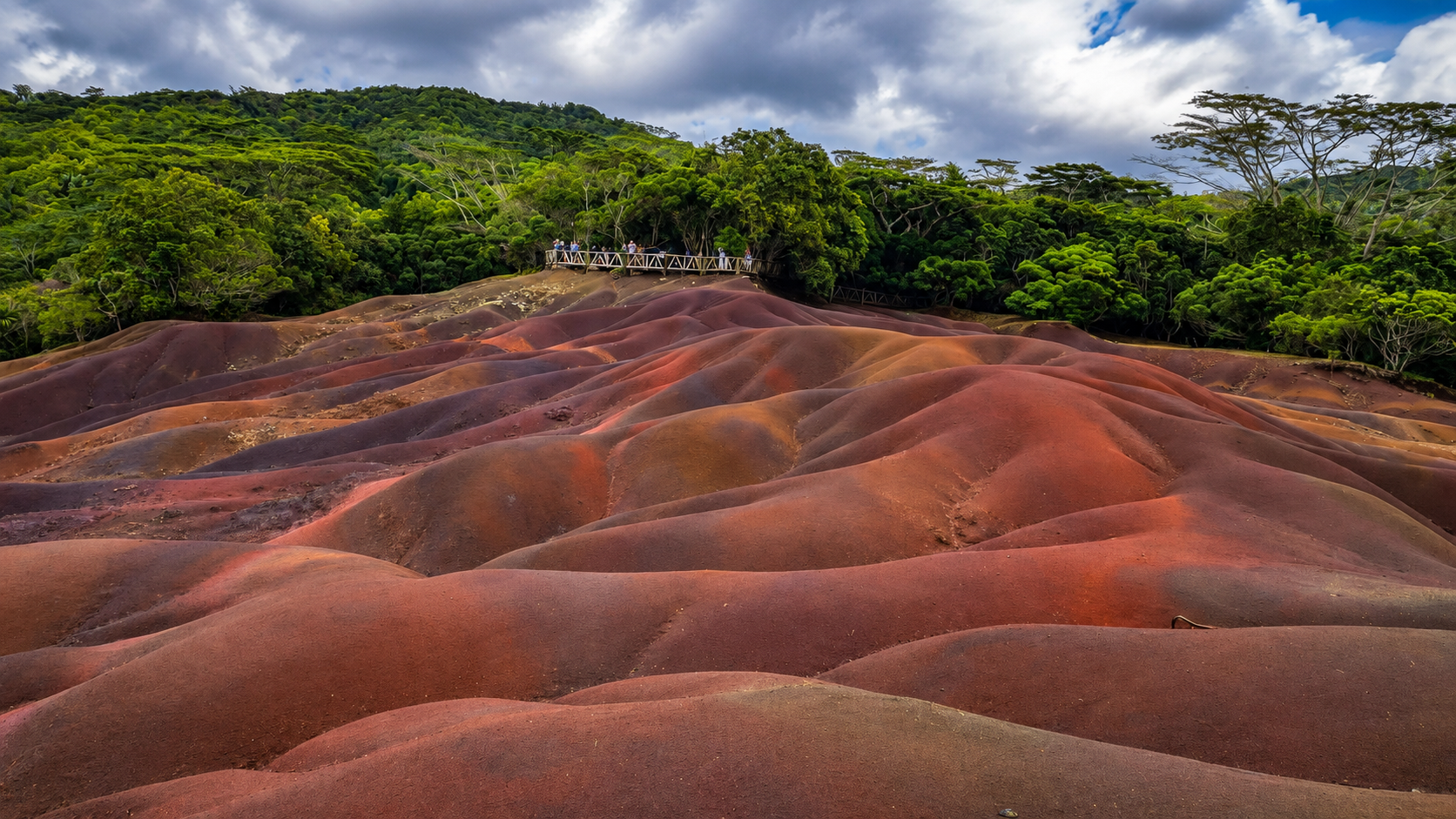
This open-air geology reveals a side of Mauritius that its lagoons alone cannot express. It is a reminder that the island was born from volcanic activity before being shaped by water, wind and living ecosystems. Beneath its familiar landscapes lies an ancient and fragile land, with each contour carrying part of its memory.
At Chamarel, the colours are more than a natural phenomenon. They offer a lesson in patience, showing that the beauty of a place lies not only in what immediately catches the eye, but also in the invisible forces that have shaped it over time.
The Seven Coloured Earth invites us to experience Mauritius differently: by reading its soil, listening to its silences and recognising, beneath the surface, the depth of an island we may only think we know.