A Living Story of Heritage and Transmission
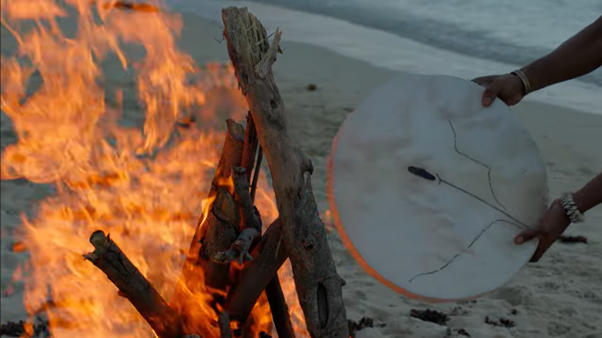
Some rhythms are learned. Others feel as though they have always been part of you. For Deelan and Fabian, Mauritian sega clearly belongs to the latter. Through the ravanne, they speak not simply about an instrument, but about a deeper connection, to their roots, their history and a culture that continues to be passed down from one generation to the next.
The music teacher and ravane craftsman, Deelan, describes its rhythm as “the beating heart of Mauritius”. Behind the sound and movement lies an older memory: that of ancestors who preserved forms of expression, music and freedom despite the hardships of history. A memory that does not belong only to the past but continues to live whenever the rhythm brings people together.
For Fabian, a ravane player who lives in Rivière Noire and grew up as the son of a seggae musician, this connection developed naturally. He is drawn to the ravanne for its cultural and ancestral meaning, but also for what it brings on a personal level. Playing becomes a moment of connection, almost a form of meditation, as well as a way of sharing the same energy with others.
Then comes transmission. Understanding how a ravanne is made, recognising the materials used, learning the gestures and rhythm, these are all forms of knowledge that matter when it comes to passing Mauritian cultural heritage on to younger generations.
Through their words, sega emerges not as something preserved at a distance, but as a living heritage: practised, felt, shared and continually renewed.
A way, quite simply, of keeping the rhythm alive.
(Music: Leon by Menwar)